
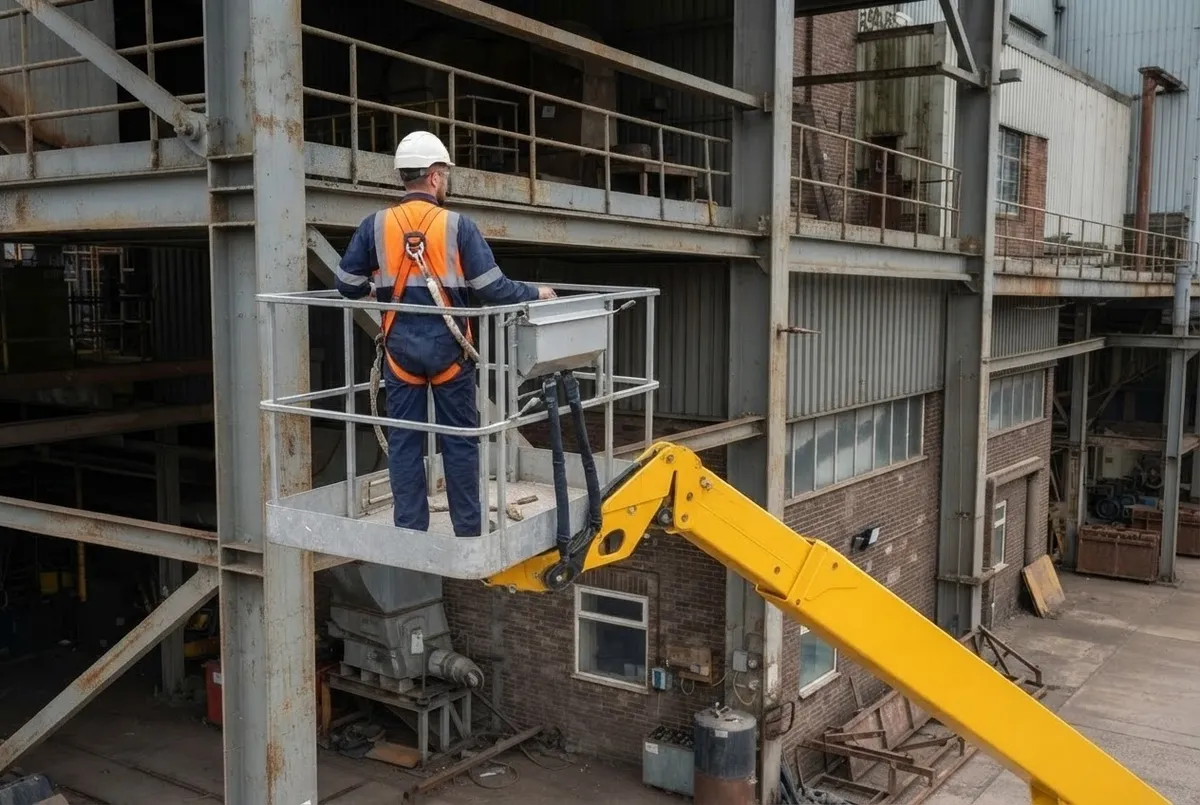
Working at Height: MEWP & Rope Access Compliance UK
By ACS Technical Team
Once a cleaning or preparation task leaves the ground, a second layer of law switches on. The equipment that lifts the operative, the harness they wear, the competence of whoever supervises and, above all, the plan for getting a suspended person down quickly all carry specific duties. In our experience of audits and site visits across UK industrial sites, it is rarely the access method that fails an inspection; it is the rescue plan behind it. This article sets out the compliance framework for MEWP and rope access work, what competence evidence actually means, and why the recovery plan deserves more buyer attention than it usually gets.
What the law requires once work leaves the ground
The Work at Height Regulations 2005 impose a hierarchy that no method statement can lawfully skip. First, avoid work at height where it is reasonably practicable to do so. Where it cannot be avoided, falls must be prevented with the most suitable measure, which is why platforms with guardrails rank above harness-based systems. Where the risk of a fall remains, the consequences must be mitigated, which is where nets, bags and fall-arrest equipment enter. Regulation 6 sets that order deliberately, and equipment choice follows it rather than leading it.
Two further duties run alongside the hierarchy. Work must be properly planned, supervised and carried out by competent people, and weather must not endanger anyone working at height. For cleaning and blasting tasks that use water, abrasive or chemicals, the planning duty extends to what happens below: people, plant and products that would be affected by anything dropped or oversprayed need exclusion and protection that is organised in advance, not improvised on the day.
Operator and supervisor competence
Competence is documented, not assumed. MEWP operators hold IPAF PAL cards for the machine categories they use, with pre-use checks recorded and harnesses inspected on a schedule by competent persons. Rope access technicians work within the IRATA framework, where level 1 works under supervision, level 2 progresses the rigging, and level 3 supervises the team and its rescue capability. For cleaning tasks the competence requirement extends beyond access: the person spraying or blasting at height must also be competent in the substance and process controls, because a fall-arrest harness does nothing for a chemical exposure.
Supervision is the buyer's quiet leverage point. A competent supervisor confirms the exclusion zone is genuine rather than nominal, checks the weather window against the task, and holds the authority to stop work when conditions change. Ask prospective contractors who that person is on your job and what authority they carry; the answer is revealing in both directions.
Why the rescue plan is usually the weak point
A person suspended after a fall can lose consciousness within minutes, and rescue must therefore be measured in minutes, not in fire service response times. For MEWP work the plan covers controlled descent by the operator, ground-level rescue of an incapacitated operator using the emergency lowering controls, and who does what if the platform itself is compromised. For rope access the plan relies on the level 3 supervisor's capability to reach and lower a casualty quickly, with the kit to do it rigged and ready rather than stored in a van.
What separates a real plan from a paper one is rehearsal and specificity. Ask when the team last practised the rescue for this configuration, not for access generally. Ask how the plan changes for work over water, over live plant or inside a roof void, because each of those changes who can reach the casualty and how. A contractor who answers those questions fluently has done the work; one who promises to figure it out on site has written your risk transfer for you.
Planning duties for buyers commissioning the work
Buyers hold duties too, chiefly around information and interfaces. Your organisation knows the floor loading, the fragile roof panels, the buried services under the standing area and the times the area below is occupied, and the access plan is only as good as that information. Handing it over early, and agreeing exclusion timings with production, is what makes the contractor's plan real. Packages that combine several access methods across one site, for example the high-level cleaning described in industrial cleaning delivered at height, benefit from one coordinating plan so that exclusion zones are established once rather than repeatedly.
ACS delivery at height
ACS delivers professional high-level cleaning using MEWPs and rope access selected by the hierarchy described above, with documented operator competence, rehearsed rescue arrangements and supervisors empowered to stop work. Where the access work sits inside a wider programme, our article on planning blasting around production shows how the same interface discipline protects the programme.
Inspection regimes for access equipment
Access equipment lives on inspection schedules, and the records are what a buyer can actually check. Harnesses and lanyards carry pre-use checks by the wearer plus formal periodic inspections recorded per item. MEWPs carry pre-use checks, scheduled maintenance and thorough examination at the required interval. Rope access kit follows manufacturer and industry inspection regimes, with items removed from service on evidence rather than optimism. What separates a working regime from a paper one is traceability: each item identifiable, each inspection dated and attributable, and each defect actioned. A buyer who samples three items at random and traces their history learns more about a contractor's culture than any certificate folder shows. The sampling habit matters more than the sample: crews who expect records to be traced keep them differently from crews who do not, and the difference shows on the day. The framework behind the machines themselves is maintained in HSE work at height guidance, alongside each manufacturer's own schedules.
Supervision ratios and when they change
Supervision needs scale with risk rather than with headcount. A single platform on open ground needs less oversight than rope teams working over live plant, and the method statement should state who supervises, at what ratio, and what triggers reinforcement. Night working, poor weather and unfamiliar sites all raise the requirement, and the honest contractors say so in the plan rather than discovering it in the schedule. Buyers should read supervision commitments as promises with dates and names attached, because that is how the crew will experience them.
Documentation buyers should retain
At the end of access work, the documents worth filing are the ones that answer future questions. Method statements and rescue plans show what was planned and for which configuration. Inspection and examination records show the equipment state during the work. Training and card copies show who was actually on site, which matters if questions arise later. Exclusion and permit records show how the operation below was protected. And a brief completion note, recording anything unusual, saves the next planner from rediscovering it. Filing these costs minutes, and the habit turns a one-off job into an asset for the site's maintenance history.
Exclusion zones deserve a paragraph of their own because they fail quietly. A barrier that nobody owns is a suggestion, and a floor marked with tape means nothing to a forklift with a deadline. Working zones are agreed with the site, physically established by a named person, and checked at every shift change, because the area below the work changes as the operation moves. Where the public or other contractors share the space, the exclusion is timed to their presence rather than assumed away.
Compliance questions answered
Do harnesses make rope access safer than a MEWP?
Neither method is inherently safer; they manage risk differently and the hierarchy decides which is appropriate. A well-planned platform with guardrails prevents falls outright, while rope access manages them through technique and rescue capability.
How current do operator cards need to be?
MEWP PAL cards and rope access logbooks should be current and checked at induction. Cards evidence training, while logbooks and ongoing assessment evidence current practice, so ask for both.
What must a rescue plan contain to be credible?
Named roles, the actual equipment staged on site, realistic timings for the specific configuration, and evidence of rehearsal. A plan that depends on calling 999 for a suspended casualty has already failed its purpose.
Who is responsible if something drops from height?
Planning duties sit with everyone in the chain, which is why exclusion zones and tool tethering belong in the method statement and are checked in supervision. Your site information contributes, because the hazards below are often yours to declare.
Does weather stop high-level work?
It can, and it should when wind, rain or lightning make the task unsafe. The method statement should define the stop conditions in advance so the decision is a threshold, not a negotiation.
