
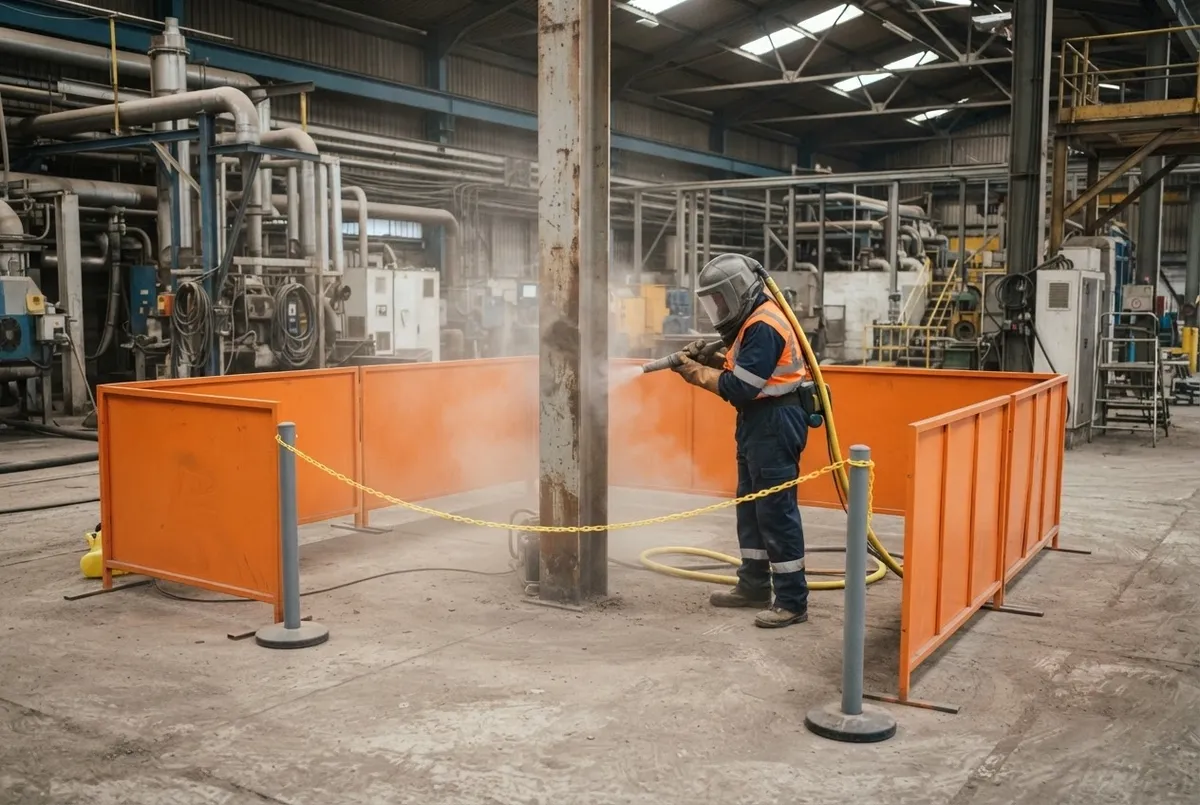
Planning a Shutdown: Shot Blasting Around Live Operations UK
By ACS Technical Team
A shutdown converts a live plant into a construction site for a few days and then hands it back as a live plant again. Everything the blasting crew does has to fit inside that conversion: the work waits for isolations, the isolations wait for production, and every hour lost at the interfaces is an hour taken from somebody else's critical path. This article is written for the people who plan shutdowns and buy the packages inside them, and it focuses on three things: sequencing, the isolation and permit boundary, and where shutdown programmes actually lose time.
Sequencing blasting work around production
Good shutdown sequencing starts weeks before the shutdown does. The blasting scope is divided into what can be prepared while the plant still runs, such as scaffolding and sheeting erected in safe zones, abrasive stored, equipment function-tested and paperwork agreed, and what must wait for the isolation. Blasting is placed in the programme where it protects its own quality: dust and debris from nearby trades ruin a freshly prepared surface in minutes, so blasting belongs early in the surface-related chain, followed quickly by coating, with both protected by exclusion from concurrent dirty work.
Windows also have a hierarchy. Some assets only give up their availability once the process has been drained, purged and proved; others are reachable in live operation with sensible boundaries. Separating those two categories honestly at planning stage is what stops a crew from standing at a fence for a shift waiting for a handover that was never going to arrive on time.
Isolation and permit interfaces
The isolation boundary is where most blasting interfaces are won or lost. The buyer's organisation normally owns the isolations, so the contractor's job is to verify what has been isolated, check it matches the method statement, and refuse to proceed where it does not. Permits follow the same logic: a blasting permit carries its own conditions on atmosphere, adjacent work, hot work boundaries and RPE, and the crew briefing should map each permit condition to a named control on the job.
Interfaces with other trades deserve explicit management because blasting dust is everyone's problem. Exhaust extraction running nearby, painters waiting for the same surface, insulation crews above and electrical teams below: each one either supports the sequence or fights it, and the daily permit meeting is where that is settled. Where blasting extends into vessels or pits, the entry regime described in our article on confined space vessel entry overlays the permit system, and both sets of controls must line up rather than compete.
Where shutdown programmes lose time
Four losses account for most of the damage. Access arriving late is the first: scaffold or platform availability that slips one day takes the whole blasting chain with it, because the crew cannot start and the coating crew cannot follow. Unknown deposits are the second, which is why survey and sample data should be bought before the shutdown, not discovered at hour six. Waste logistics are the third, because bags of spent media that nobody arranged to move block walkways and, on hazardous streams, consignment lead times are measured in days. The fourth is slow decision-making at the wrong hour, when a two o'clock question about a changed surface condition waits until the next morning's meeting for an answer that took thirty seconds.
Each loss has a standard antidote. Access ownership is put in writing before the shutdown begins. Charter a survey that characterises deposits and coatings on the assets actually in scope, and read the results against what industrial blasting standards demand of the substrate. Book waste routes and skips with the programme, not after it. And agree a named decision-maker with the authority to vary the sequence out of hours, because the clock does not pause for the meeting cycle.
Protecting the critical path
Critical path protection on a shutdown is mostly about buffers and honesty. Buffers belong where interfaces meet: between isolation and first blast, between blasting and first coat, and between final clean and handback, each sized to the risk behind it. Honesty belongs in the daily schedule meeting, where completed work is reported against the standard actually achieved rather than the plan hoped for, because a surface claimed as ready that fails inspection on Monday has stolen two days the schedule never had. Contractors who report progress in specification terms, with grades verified rather than asserted, are the ones protecting your path rather than their invoice.
ACS on your shutdown
ACS plans blasting within shutdown programmes around the interfaces described here: sequence agreed with the client's own isolation and permit process, progress reported in specification terms, and crews sized to the window rather than to the wish. Shutdowns reward contractors who have planned this work before, and penalise those learning on your critical path.
Handback and restart discipline
The end of a blasting scope is a document, not a feeling. Handback should record what was prepared, to what grade, verified by whom, and what protection the surface carries until the next trade takes it over. Interim protection matters because prepared steel left overnight beside a dusty trade has quietly regressed, and the argument about whose fault that is takes longer than the protection would have. Where blasting precedes coating inside the same window, the handback record should carry surface condition at transfer, because that timestamp settles most quality disputes before they start. Restart criteria agreed in advance end the conversation about whether the surface is ready, because the answer is on the sheet rather than in the room. Buyers who insist on signed handback per area get programmes that finish honestly, and get a record that protects both sides when memory diverges.
Interfaces: who supplies what
Shutdown packages fail at unowned boundaries. Power for lighting and tools, water for dust suppression, scaffold access, waste skips, welfare and parking each have an owner, and the method statement should name them. The blasting contractor's own plant, fuels and consumables belong on the same list, with delivery windows matched to the site's rules. Where interfaces sit with other contractors rather than the client, the coordination route needs an owner too, usually the client's own supervisor. A one-page responsibility matrix agreed before mobilisation costs an hour and prevents the classic shutdown scene of two crews each assuming the other arranged the access. Where the plant sits under major-accident regulations, the maintenance arrangements operators are expected to run are framed by the HSE publication on process safety, and contractors work inside that framework.
Learning loops between shutdowns
Sites that run repeated shutdowns improve by writing down what the last one taught. Deposit behaviour that differed from the survey, access that arrived late, decisions that waited for a meeting: each becomes a planning input for the next window. Contractors who keep and share those lessons, rather than rediscovering them, are worth more than a price difference on the first package. Buyers can force the loop by asking for a short lessons log at handback, written for the people who will plan the next one rather than for the archive.
One habit protects shutdown blasting more than any other: writing the sequence on one page that everyone recognises. Isolation, access, blast, clear, inspect, coat, handback, with owners and times beside each step, survives the noise of a shutdown better than a plan spread across documents. Crews and client staff orient themselves against the page at every shift start, and deviations are visible while they are still cheap.
Shutdown planning questions
How early should blasting scope be fixed?
Before the shutdown window is confirmed, so that survey, access design and waste routes can be bought in advance. Late scope changes are the most expensive kind because they consume the buffers that protect the path.
Who owns the isolations for blasting areas?
Normally the client organisation, with the contractor verifying and working to them. The division of that responsibility belongs in the method statement, not in an assumption made on the morning.
Can some blasting happen before the shutdown starts?
Often yes, on assets or areas where safe distances can be maintained from live operations. Moving that work out of the window releases time for the work that genuinely needs the plant off.
What single agreement saves the most time?
A named out-of-hours decision-maker with authority to approve sequence changes. Most avoided delays cost nothing but a phone call at the right hour.
How is progress measured on the critical path?
In specification terms: areas prepared to the agreed grade and verified by inspection, not square metres claimed. That is the only progress number that predicts whether coating can start on time.
