
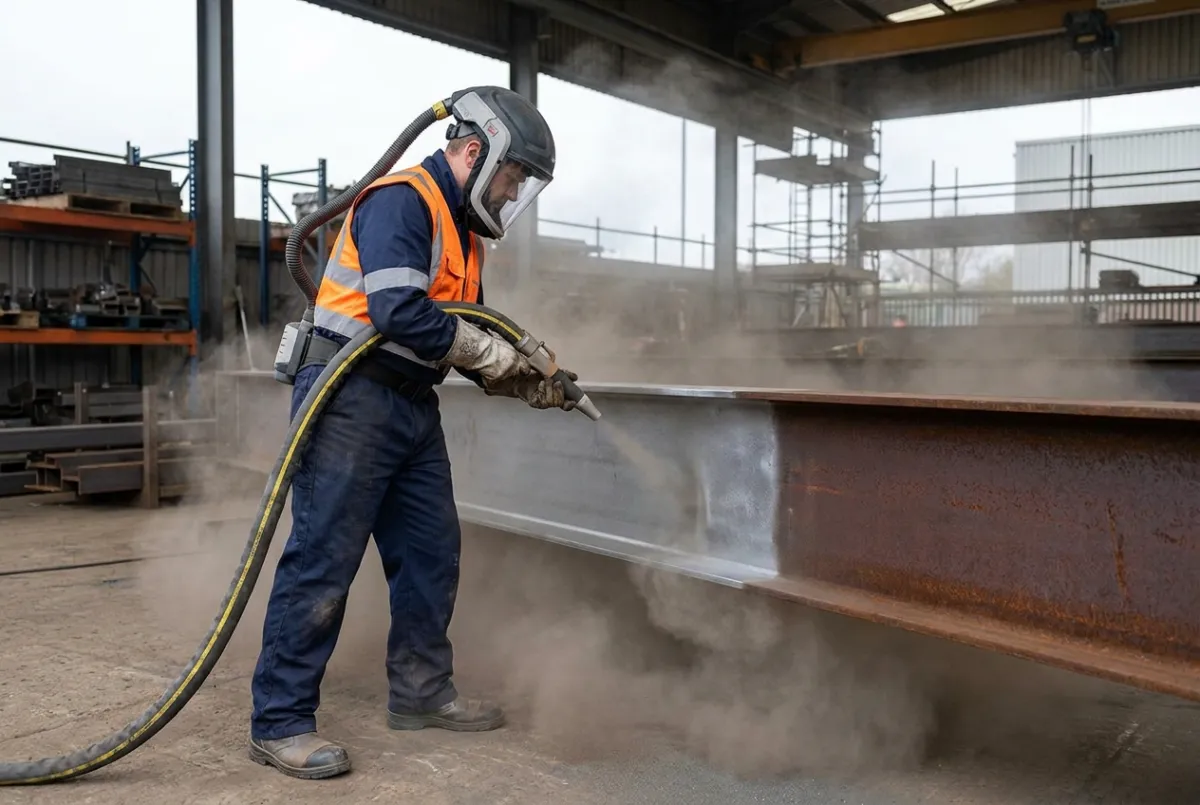
Industrial Shot Blasting & Surface Preparation UK
By ACS Technical Team
When protective coatings fail early, the root cause is often not the paint itself but the condition of the surface underneath it. Industrial shot blasting and surface preparation are the stages that decide whether a coating system bonds properly, whether corrosion is left active below the film, and whether a client gets a realistic service life instead of an avoidable return visit. For buyers comparing contractors, the important question is not simply who can blast steel. It is who can assess the substrate correctly, select the right abrasive, achieve the specified cleanliness standard, and control the period between preparation and coating.
For UK industrial assets, that matters because steelwork rarely arrives in one neat, uniform condition. One section may carry intact shop primer, another may be heavily corroded, and another may be contaminated with salts, grease or historic coating residue. Treating all of it the same is how projects drift into rework. A well-run surface preparation package starts with inspection, not with switching on the blasting pot.
If you are procuring this type of work, the most useful way to review a proposal is to ask how the contractor will define the starting condition, what standard they are working to, and how they will prevent freshly prepared steel from deteriorating again before the next trade begins. That is the practical difference between surface preparation as a line item and surface preparation as a controlled process.
Why surface standards matter more than generic “clean steel”
Terms such as SA 2.5 and SA 3 are not sales language. They are shorthand for how thoroughly contamination, mill scale, rust and previous coatings have been removed from steel. In broad terms, SA 2.5 is very thorough blast cleaning and is widely specified for high-performance coating systems; SA 3 is blast cleaning to visually clean steel, used where the specification demands the highest level of visible cleanliness and the substrate condition justifies it. The exact visual criteria are set out in ISO 8501-1.
What matters commercially is that the jump from “generally looks clean” to “prepared to the specified standard” is where time, inspection discipline and abrasive selection sit. If a coating datasheet or client specification expects SA 2.5 and the actual result is patchy, with staining, tightly adherent residues or contamination left in pits and edges, the coating may still be applied but its performance envelope has already been weakened. Adhesion, corrosion creep and underfilm breakdown often begin from that point.
There is also a decision to make about whether the required finish is achievable on the material presented. Deep pitting, laminated steel, old incompatible coatings and heavy chlorides can all complicate the route to a standard. A credible contractor should say so early. That conversation is far more valuable than vague assurances that everything will be “taken back to bare metal”.
The substrate condition should set the method
Before any blasting plan is priced properly, the substrate needs to be categorised. Questions that affect method and budget include:
Is the steel new, weathered or already coated?
New fabricated steel may need profile creation and removal of mill scale, but the labour profile differs from heavily corroded structural steel with multiple historic paint layers. Previously coated surfaces can require removal of brittle or incompatible systems rather than straightforward preparation.
Are contaminants visible or invisible?
Oil, grease and process residues can be obvious. Soluble salts are not. If contamination is not identified and dealt with before or during preparation, the project can reach its visual standard while still carrying a hidden cause of premature coating failure.
What profile does the new coating system require?
Surface cleanliness is only part of the story. The blast profile must suit the coating system being applied afterwards. Too shallow and the coating may not key properly. Too aggressive and thin-film systems can bridge peaks poorly, creating weak points and over-consumption.
How accessible is the workface?
A workshop floor, a live industrial elevation, and a marine structure open to wind-driven moisture will each push the method and containment arrangements in different directions. If the access strategy is wrong, production slows and dust or spent abrasive control becomes harder than it should be.
Abrasive media selection is not an afterthought
One of the clearest signs of competent planning is that the abrasive has been selected for the substrate, specification and containment arrangement rather than chosen by habit.
Steel shot and grit are often used in controlled recovery systems where productivity and profile consistency are priorities. Chilled iron, mineral abrasives and other expendable media may be more appropriate on certain site-based operations or where contamination control, shape and finish requirements differ. The particle size and hardness influence cleaning rate, anchor profile and overall consumption. On fragile substrates or mixed-material environments, an over-aggressive choice can create damage, not just cleanliness.
Buyers should also be wary of quotes that reduce blasting to square metre output alone. Fast production is welcome, but only if it still produces the required standard and profile across welds, edges, pits and awkward geometry. Large flat areas are the easy part. Real quality is usually exposed at brackets, flanges, cut-outs and transitions.
Where the next stage is protective painting, it is sensible to plan the preparation and coating package together. ACS covers both aspects UK-wide, so shot blasting and surface preparation services can be procured under a joined-up specification rather than as isolated trade packages. If you are also reviewing coating performance expectations, that aspect of the package sits with industrial coatings and protective painting.
Why poor preparation shortens coating life
Premature coating failure is usually expensive in the dullest possible way: not dramatic enough to be called a major incident, but disruptive enough to trigger snagging, reattendance, early repainting and procurement frustration. In industrial settings, the most common preparation-related problems include:
residual rust left in pits or tight details;
contamination trapped below the first coat;
inadequate edge preparation;
flash rusting before overcoating;
incorrect surface profile for the coating system;
poor housekeeping between blasting and painting;
inconsistent work across different crews or shifts.
A coating can look acceptable on handover and still fail earlier than expected because the preparation stage was treated as a throughput exercise. That is why inspection timing matters. Surface condition should be checked when the steel is available for review, not after it has sat exposed while other site priorities intervene.
On exposed jobs, especially where moisture or airborne contaminants are an issue, the window between blast cleaning and first coat is critical. Delays that seem minor on paper can materially change the substrate. This is one reason surface preparation often needs to be programmed tightly with the coating application team rather than left floating between trades. On harsher environments, the marine and offshore surface preparation perspective is also relevant.
Practical controls that separate a reliable package from a risky one
A buyer does not need to micromanage blasting operations, but a few checkpoints are worth insisting on.
Pre-start review
The contractor should be able to identify steel condition, existing coating issues, contamination concerns, access constraints and containment requirements before the work begins. If sampling or trial areas are sensible, they should say so.
Agreed preparation standard
The quotation and method should describe the target preparation standard clearly, not hide behind general phrases such as “thoroughly cleaned” or “fully prepared”.
Abrasive and profile suitability
There should be a reasoned answer on media type, expected profile and compatibility with the specified coating system.
Cleanliness before coating
Dust, residue and recontamination control need attention after blasting, not just during it. The surface should be handed forward in a condition the coating applicator can use.
Sequence discipline
Freshly prepared areas should not sit unnecessarily while weather, humidity, process contamination or adjacent works undo the result.
Indicative costs, programme factors and what moves a quote
Pricing for industrial shot blasting in the UK is never genuinely one-size-fits-all. Access, containment, substrate condition, waste handling, abrasive choice, profile requirements, coating interface and programme pressure all matter. Location matters too: ACS works UK-wide from a North Wales / North West England base, and travel and subsistence are built into quotes where required.
As a broad guide only, small localised preparation works may come in from the low hundreds, while structured multi-day site packages with containment, higher-control access and coordinated follow-on coating works can move into several thousands or substantially more. On heavier industrial steelwork, the biggest cost drivers are usually access complexity, contamination level, required finish standard and the need to maintain or isolate surrounding operations.
Programme duration varies in the same way. A small workshop batch can be turned round quickly. A live industrial site with difficult geometry, dust control measures and sequencing restrictions may require a much longer mobilisation. Treat any early number as indicative and non-binding until the workface, access method and specification are properly reviewed.
Why buyers use ACS for this type of work
Alternative Cleaning Solutions (NW) Ltd operates across the UK with a core in-house team and vetted, accredited subcontractors brought in where project scale demands it. That model matters on surface preparation because the work often needs the right combination of labour, access capability and specification control rather than a simplistic promise about employment structure. The business has 26 years' experience and cites recognised credentials including FSB membership, Builder's Profile verification and Constructionline Gold.
For facilities managers and procurement teams, the practical value is that the conversation can stay grounded in substrate condition, preparation standard, access and programme risk. That is usually what decides whether the next trade inherits a usable surface or a problem.
Frequently asked questions
Do I need SA 2.5 or SA 3?
That depends on the coating specification, environment and asset criticality. SA 2.5 is commonly used for high-performance systems and is sufficient for many industrial applications when executed properly. SA 3 is more stringent and can be justified where the specification, exposure conditions or client standard require it. The right answer should come from the coating system and substrate review, not from habit.
Can blasting start before the coating product is chosen?
It can, but that is not ideal. Surface profile and cleanliness need to align with the coating that follows. If blasting is priced and programmed in isolation, there is a greater risk of extra cost later because the prepared finish does not match the coating manufacturer’s requirements.
What causes flash rust after blasting?
Freshly prepared steel can react quickly when humidity, condensation or contamination are present. Delays between preparation and priming, poor environmental control and exposure to damp conditions all increase the risk. On some sites, the answer is tighter sequencing rather than simply working faster.
Is shot blasting always the right option?
No. Some substrates, environments or live-site constraints may point towards other preparation methods or a mixed-method approach. A competent contractor should explain where blasting is the best fit and where it is not.
Do UK-wide quotes include travel?
Travel and subsistence are not ignored. They are factored into project pricing according to location, duration and crew requirements, so a site in one region will not necessarily price the same as an equivalent scope close to base.
