
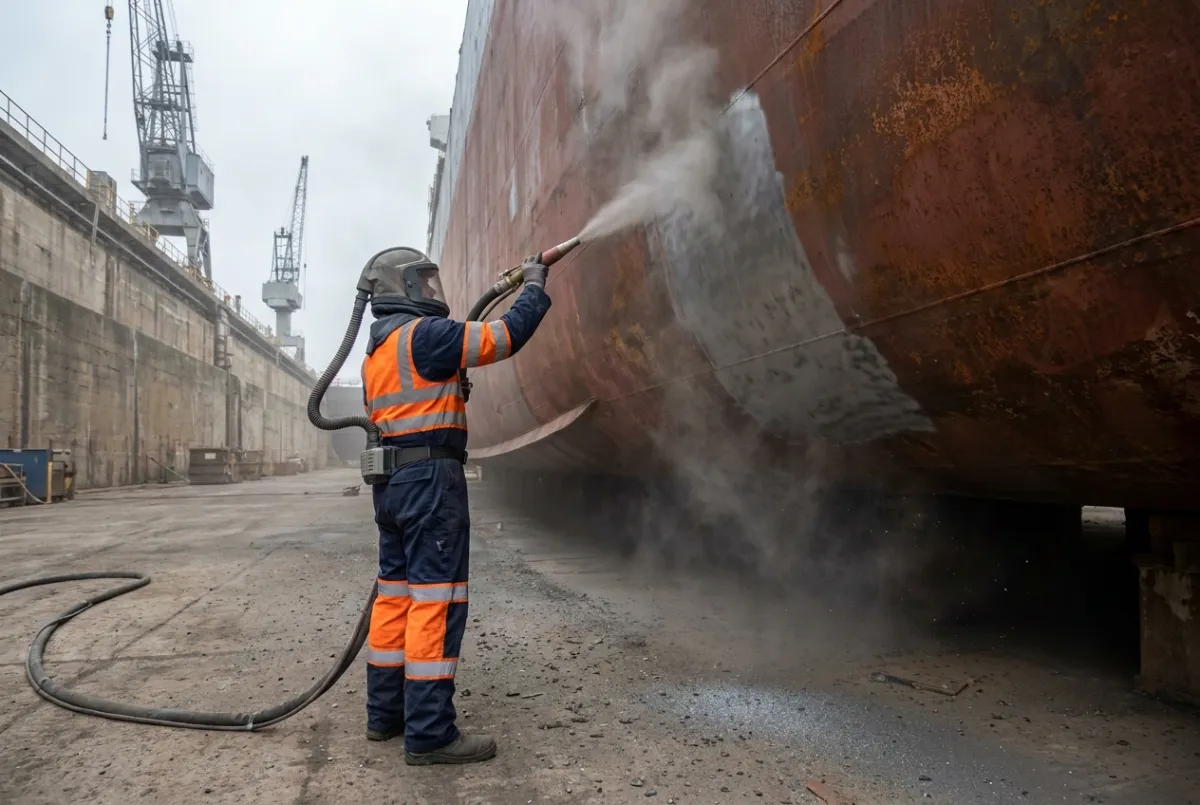
Marine & Offshore Surface Preparation Services UK
By ACS Technical Team
Marine and offshore surface preparation leaves much less room for delay than comparable inland work. On a conventional industrial site, a prepared substrate may already have a short usable window before contamination or moisture becomes a concern. On marine structures, coastal assets and offshore-facing environments, that window can tighten further because salt deposition, moisture cycling, wind exposure and limited access periods all press on the programme at once. The margin between “properly prepared” and “already starting to degrade again” can be uncomfortably small.
That is why buyers in this sector should look beyond generic blasting capability. The real question is whether the contractor understands how exposure conditions, weather windows, tidal influence and recoat timing affect the viability of the whole package. Surface preparation in marine settings is not just a precursor to coating. It is a race against an environment that will actively undo good work if sequencing is weak.
For procurement and facilities teams, the commercial consequence is simple: marine preparation must be planned with tighter controls than many inland packages. If those controls are missing from the quotation stage, cost overruns or premature coating problems become more likely later.
Salt and soluble contamination change the risk profile
A marine substrate does not have to be visibly wet to be a marine risk. Salt contamination and repeated moisture exposure can remain relevant even when the steel appears dry and workable. If soluble contamination is left in place or reintroduced before coating, the system can fail from beneath the film far earlier than expected.
This is one reason marine work should not be priced as though it were ordinary yard preparation with a different postcode. The environment influences:
how contamination is assessed;
how long prepared steel can remain exposed;
when coating can follow preparation;
whether repeated cleaning or checking is necessary;
how much contingency the programme needs for weather interruption.
The HSE guidance on material and corrosion control is a helpful reminder that corrosion and material selection issues are not abstract in exposed environments; they are core engineering concerns.
Access windows are often dictated by more than labour availability
Inland industrial jobs can already be constrained by shutdowns, permits and shared access. Marine and offshore-facing works add further pressures. Depending on the asset, you may be dealing with:
Tidal constraints
Certain areas are only practically reachable, safe or sensible to work on during limited windows. That affects both production rate and the size of the crew required.
Weather interruptions
Wind, spray, rain and rapid shifts in ambient conditions can stop work or alter the coating sequence after preparation has begun.
Exposure during the handover between trades
The time between surface preparation and coating is usually critical. In exposed marine settings, it becomes even more so.
Logistics and waste handling
Moving abrasive, containment kit, access equipment and waste off difficult marine locations takes longer and should be priced accordingly.
The point for buyers is that programme confidence comes from understanding these restrictions honestly. A quote that assumes uninterrupted progress may not be competitive once the true environment is considered.
Dwell-time pressure is one of the defining marine issues
In a marine context, dwell time means more than how long a crew is on site. It also describes how long the substrate or the partly completed coating system is left exposed between stages. That pressure shapes method decisions from the start.
If the steel is prepared but the coating cannot be applied promptly because of weather, access loss or environmental limits, the surface may need rechecking or re-preparation. That is expensive, but it is often more expensive to ignore the issue and press on. The correct route is controlled sequencing, not optimistic sequencing.
This is where a joined-up view of preparation and coating pays off. Marine preparation that is procured in isolation can create a problem for the painting stage. Where the wider protective system is part of the scope, it is covered under industrial coatings and protective painting.
The substrate review needs to be harsher than on typical inland jobs
Marine assets often combine corrosion, old coating remnants, impact damage, crevice areas and awkward geometry in the same workface. That increases the need for careful survey. Issues that deserve attention early include:
extent of pitting and whether nominal surface cleanliness will be enough;
evidence of repeated wetting and salt loading;
condition of edges, welds and fixings;
whether the asset can be enclosed or shielded during preparation and coating;
interface with adjacent live operations or marine traffic;
whether a trial area is sensible before a broader commitment is made.
Where buyers want a deeper explanation of general blasting standards and substrate assessment before applying that marine lens, industrial shot blasting and surface preparation is the companion article.
Why marine surface preparation tends to cost more than inland equivalents
Marine pricing is rarely driven by square metres alone. The extra cost usually comes from the environment’s effect on productivity and risk control. Typical drivers include:
More difficult mobilisation
Access, transport, storage, containment and waste routes can all be slower and more controlled than on a conventional industrial estate job.
Lower output certainty
Weather and access windows reduce the predictability of daily production.
Higher need for coordinated sequencing
Preparation and coating may need to follow each other closely, with less tolerance for delay.
Greater inspection discipline
Because the environment is so unforgiving, it becomes more important to confirm that preparation and contamination control are acceptable before coating continues.
This does not mean every marine package is disproportionately expensive. It does mean the method statement and programme assumptions deserve closer examination than they often receive.
ACS’s marine and offshore work sits on the marine and offshore surface preparation service route.
Indicative commercial picture
As with any specialist industrial service, firm pricing depends on the actual structure, access, exposure, specification and programme. Travel and subsistence vary by region and logistics, and ACS prices UK-wide work from its North Wales / North West England base accordingly rather than presenting an artificial distance-neutral rate.
Indicatively, smaller controlled scopes on accessible coastal assets may begin at several thousand pounds once mobilisation, environmental controls and sequencing are considered. Larger or more exposed projects involving difficult access, containment, short weather windows and tight coating follow-on can rise well beyond that. Any cost guide should be treated as indicative and non-binding until survey information is confirmed.
Duration estimates need the same caution. A task that appears to be three days of physical blasting may become a much longer package once tidal restriction, weather downtime and coating interface are priced honestly.
Why ACS fits this category of work
Alternative Cleaning Solutions (NW) Ltd brings 26 years' experience to UK-wide industrial works and operates through a core in-house team supported by vetted, accredited subcontractors when project size or specialist demands require extra capability. In marine settings, that flexibility can be useful because the solution often depends on combining labour, access and programme control rather than sending a generic crew. The firm references FSB membership, Builder's Profile verification and Constructionline Gold.
For buyers, the main test remains whether the contractor understands how quickly exposure conditions can compromise a prepared substrate and whether the proposed sequence reflects that reality.
FAQ: marine and offshore buyer concerns
Why are marine preparation windows so tight?
Because salt exposure, moisture cycling and weather can affect the substrate much faster than on many inland sites. The time between preparation and coating therefore becomes more sensitive and must be controlled carefully.
Does marine work always require a different blasting standard?
Not necessarily a different standard, but it often requires tighter contamination awareness, stricter sequencing and more attention to exposure conditions. The environment narrows the tolerance for delay and weak preparation.
Can work continue in poor weather if the team is already mobilised?
Not if conditions would compromise safety or the technical quality of the result. Continuing simply to avoid downtime can lead to rework or early coating failure.
Why do access and logistics affect cost so much?
Because marine locations often require more controlled movement of people, equipment, abrasives and waste, while also dealing with restricted work windows and exposure-related stoppages.
Are nationwide quotes adjusted for location?
Yes. Travel, subsistence and logistical implications are reflected according to the project location and duration. There is no genuine flat UK-wide price that ignores geography.
