
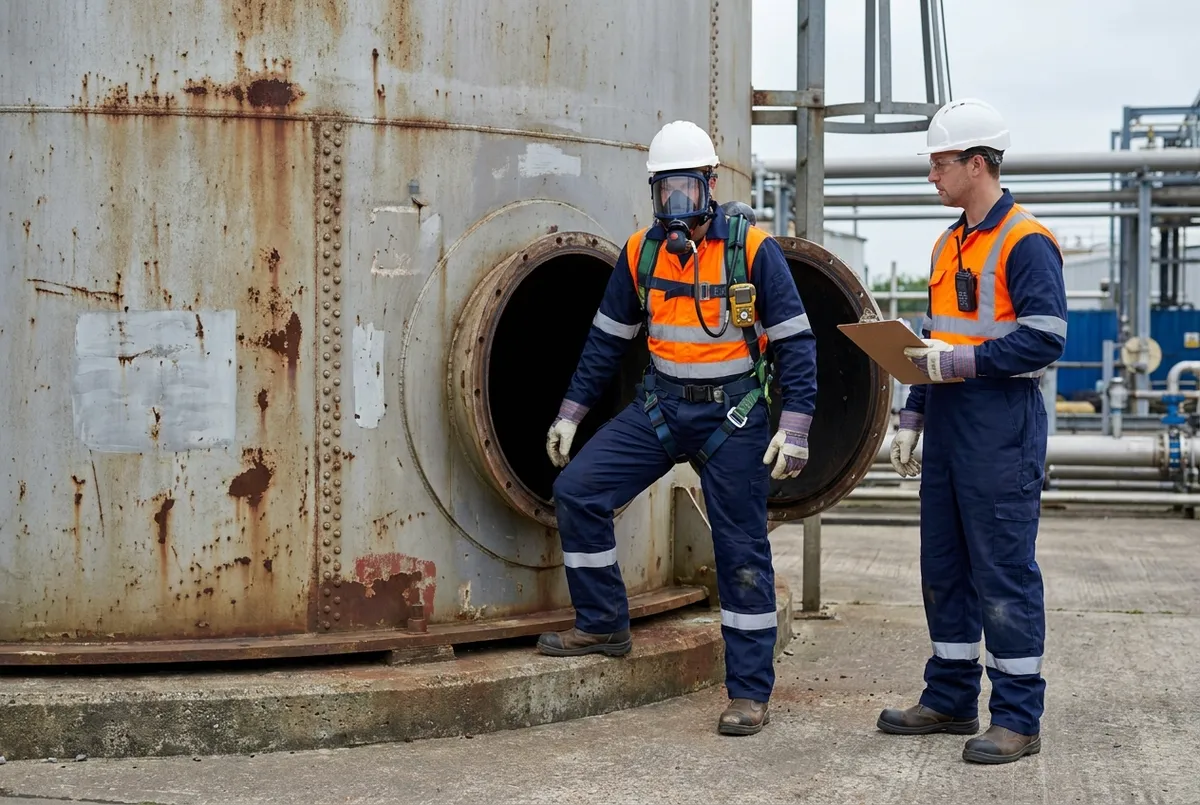
Confined Space Entry for Tank & Vessel Work UK
By ACS Technical Team
Most of the risk in tank and vessel cleaning is decided before anyone unbolts a manway. The decisions that matter are taken at survey and planning stage: whether entry is necessary at all, what the atmosphere regime will be, and how a casualty would actually be recovered from the geometry that exists rather than the one shown on a thirty-year-old drawing. This article works through that sequence for buyers scoping vessel work, because the quality of those early decisions is what a quotation is really pricing.
Entry or no entry: the first decision
The Confined Spaces Regulations 1997 begin with a prohibition: nobody must enter a confined space to carry out work if that work can reasonably be done without entry. That requirement shapes everything downstream. Cleaning-in-place systems, remote mechanical aids, circulation flushes and external inspection techniques can remove people from the vessel altogether on some packages. Where deposit character is uncertain, the honest sequence is to plan the no-entry attempt first, review what it achieved, and only then plan the entry that remains, because the entry that is no longer needed is the cheapest risk control available. The residual entry is often a targeted inspection or a manual intervention at one location, which is a different job to plan from full-scale internal cleaning.
The safe system for the entry that remains
Where entry is genuinely required, the safe system is built from isolations, atmosphere control and supervision. Isolation is physical and verifiable: mechanical drives locked off, valves blanked or chained, inlets drained and flushed, with a register that names each isolation and who applied it. The permit-to-work then governs who enters, when, on what atmosphere result, and what work is allowed inside, so no hot work proceeds on a permit written for cleaning, and no exceptions arise without a fresh assessment. Communication arrangements, a trained top man who never enters, and an agreed withdrawal trigger complete the structure. HSE's L101 guidance sets out these expectations in detail, and contractors should be able to show their system mapped against the L101 guidance on safe entry when asked.
Atmosphere testing regimes
Atmosphere is tested, never assumed. Pre-entry testing covers oxygen level, flammability and the toxic gases the vessel's history suggests: hydrogen sulphide for sour systems, carbon monoxide where sludge may be generating it, product vapours where residues remain. The order of testing matters because sensors respond differently and vapours stratify, so oxygen is tested first, then flammables, then toxics, at the top, middle and bottom of the space through the intended access route. Results control the entry. A vessel is entered to the conditions stated on the permit, and if the atmosphere changes mid-shift, the permit conditions decide what happens next.
Two failure modes catch teams out. Stratification means a single reading at the manway tells you almost nothing about a deep or compartmentalised vessel. And sludge is an atmosphere source: disturbance during cleaning can release gases hours after a clean pre-entry certificate, which is why continuous or frequent periodic monitoring runs for the whole duration of occupation rather than only before it.
Why vessel geometry dictates the rescue plan
Rescue planning is where generic paperwork falls apart, because geometry is specific. A shallow horizontal tank with two 600 millimetre manways is a different rescue problem from a twelve-metre vertical vessel with internal baffles, or a pit with a single narrow entrance. The plan must answer practical questions: whether a casualty in a harness can actually be moved to the manway, and by which route; what retrieval equipment fits the access; whether a trained internal rescue team with self-contained breathing apparatus is needed on standby instead of a tripod on the surface; and how long air-supplied movement through the baffles realistically takes. A rescue plan that says the fire service will be called, without addressing the interval between collapse and arrival, has not been written for the vessel in question.
ACS and vessel cleaning delivery
ACS plans and delivers tank and vessel cleaning around this exact sequence: entry avoided where reasonably practicable, and where it is not, isolations, atmosphere regimes and rescue arrangements designed for the specific geometry found at survey. Internal vessel work is one part of a wider site picture, so packages that also include general and high-level cleaning benefit from a single coordination layer across all of it. Our broader article on confined space cleaning delivery covers the operating model in more depth.
Working around services and product residues
Vessels rarely present clean geometry. Heating coils, dip pipes, agitators and level instruments turn a simple shell into an obstruction course, and each one is both a cleaning problem and a rescue problem. Services that pass through the space need identifying at survey, because a line assumed dead that is merely closed has ended careers. Product residues add their own behaviours: some sludges give off gas as they warm, some scale releases suddenly when struck, and some residues react with the cleaning water itself. The method statement should name each of these behaviours for the actual vessel, with the control listed beside it, because generic language about residues is where planning stops matching the asset.
Matching training to the space
Confined space competence is specific to the kind of space as well as the activity. Vertical entry with retrieval gear, horizontal runs with air lines, and work behind baffles each demand practice that a general certificate does not prove. Ask how the team's last entry compared with yours, and what changed in their plan as a result. Crews who work vessels regularly answer in specifics about air changes, communication arrangements and retrieval angles, and that specificity is the best evidence of competence a buyer can gather in a phone call. The same logic applies to the top man, whose role deserves its own training rather than a borrowed harness and good intentions.
Records the client should expect to keep
Confined space work generates a paper trail that outlives the job, and buyers should expect copies rather than summaries. Isolation registers and their verification records show what was made safe and by whom. Gas test logs, with instrument serials and calibration status, show the atmosphere regime was followed rather than asserted. Permits, including their cancellation, show the boundary of authorised work. Rescue equipment checks and the standby log show the plan was resourced for every hour of occupation. And the handback record ties the cleaning result to the agreed standard. Together these records are the difference between a job that went well and a job that can show it went well, which matters long after the crew has left.
The interval between the survey and the work deserves a word too. Vessels change between the drawing and the day: liners fitted, coils added, residues hardened over a season of running. A short re-survey at the point of mobilisation, or at least a photo review with the operations team, closes the gap between the plan written and the vessel found. Packages that skip this step are the ones that discover their rescue plan fits a previous version of the asset, and the discovery always arrives at the worst hour of the window. The same review is where access equipment choices are checked against what is actually fitted to the nozzle side of the job.
Common questions about vessel entry
Can the vessel simply be ventilated until the reading is clean?
Ventilation manages an atmosphere, it does not remove the hazard source. Sludge and scale keep generating gas, so ventilation is one control inside the regime and never a substitute for testing, isolation and ongoing monitoring.
Who carries out the atmosphere testing?
Trained, competent personnel with calibrated gas detection, applying the correct order of tests and recording results against the permit. Instruments are bump-tested and calibrated on a schedule, and the records should be available on request.
Is a tripod enough for rescue?
Only where the geometry allows a casualty to be brought to the retrieval point without obstruction. Vertical vessels with baffles, long horizontal runs or narrow entrances usually need a trained internal rescue capability instead.
Do we need to drain the vessel before entry?
Where reasonably practicable, yes, and isolations should make re-filling physically impossible. Entry in order to pump out residues is a planned activity with its own controls, not an informal first step.
What does the permit actually control?
Who is inside, at what time, on what atmosphere results, doing what work, with what communications and withdrawal triggers. If activities change, the permit changes with them, because a permit is the boundary of what is authorised and not a form-filling exercise.
