
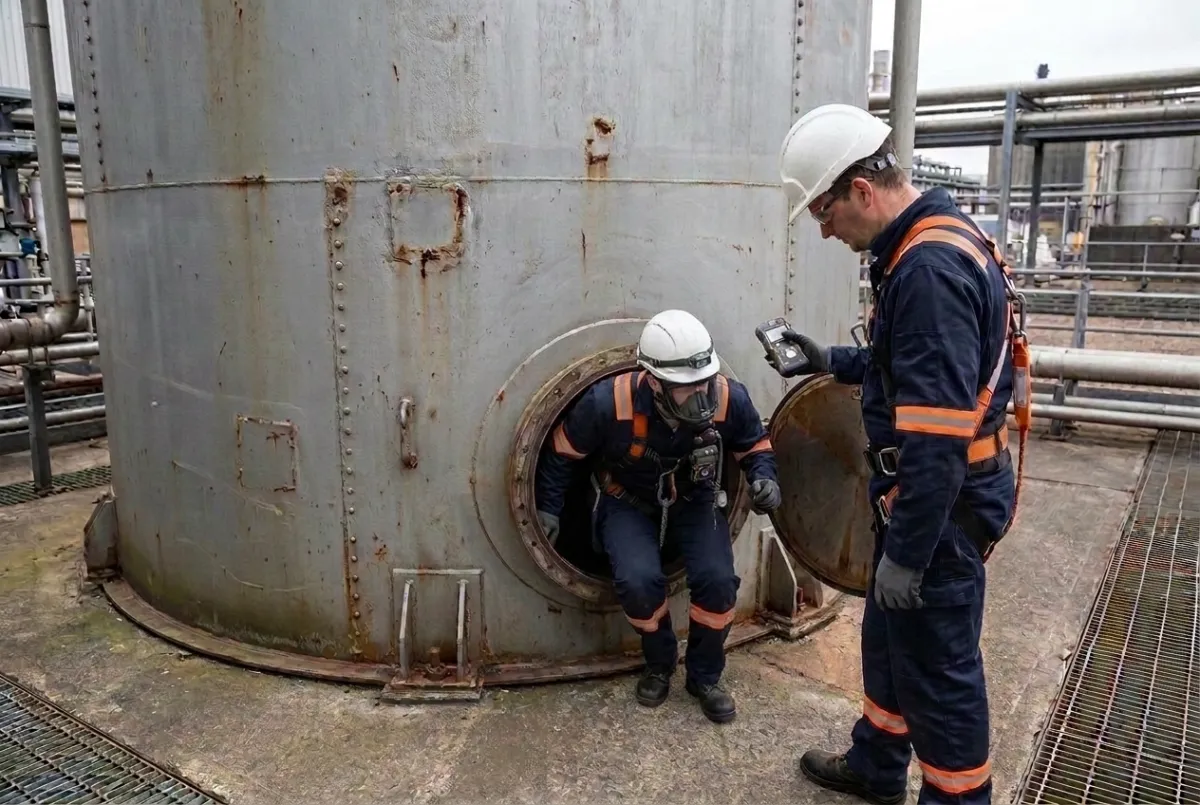
Confined Space & Industrial Plant Cleaning UK
By ACS Technical Team
The first decision in confined space cleaning should be whether anybody needs to enter the space at all. That point is often missed when a client is under pressure to clean a vessel, pit, duct, sump, tank or process void quickly. Entry is not a routine operational convenience; it is a last-stage decision made after isolation, external cleaning options, remote methods and ventilation strategies have been considered properly. In practical terms, the safest confined space entry is the one that never becomes necessary.
Where entry genuinely is required, the quality of planning determines whether the job is merely difficult or needlessly dangerous. Industrial plant cleaning inside enclosed or partially enclosed spaces involves changing atmospheres, uncertain residues, awkward geometry, restricted rescue routes and multiple interfaces with the client’s own permit and isolation systems. Buyers should therefore judge contractors less by broad claims about “specialist cleaning” and more by how they manage entry risk, atmosphere testing, rescue readiness and plant isolation.
That is especially important on UK industrial sites where conditions can change mid-task. A space that tests acceptably at the hatch does not automatically remain safe deeper inside. Residues can release vapours when disturbed. Oxygen levels can alter as ventilation changes. Cleaning methods themselves can change the atmosphere. This is why confined space work needs disciplined control from the planning stage onwards.
Entry should follow necessity, not habit
One of the most useful questions a facilities manager can ask at the outset is: can this be cleaned from outside, from above, or by another access method that avoids full entry? Sometimes the answer is yes. High-level vacuuming, external washdown, lancing from a safe point, or mechanical removal before human entry can materially reduce time spent inside the hazard envelope. Where the problem is actually an access issue rather than a confined-space issue, high-level cleaning services on adjacent plant or structures may be the more sensible route.
If a contractor immediately assumes bodily entry without first discussing isolation, residue type, ventilation and non-entry options, that is usually a warning sign. The planning conversation should cover:
what material is being removed;
whether the plant can be fully isolated and proven dead;
how the atmosphere will be tested and re-tested;
whether continuous monitoring is needed;
what rescue method is viable for that geometry;
how long operatives are likely to remain in the space;
whether the work can be staged to reduce exposure time.
The governing principles are well established in HSE guidance on safe work in confined spaces, and any credible contractor should be comfortable discussing them in site-specific terms rather than reciting them generically.
Atmosphere testing is a decision-making tool, not a paperwork exercise
Atmospheric monitoring is sometimes treated as a box to tick before work begins. In reality, it should influence whether the work proceeds, how it is performed, what PPE is appropriate, and whether conditions have shifted enough to pause and review.
Pre-entry testing
Before anyone goes inside, the atmosphere needs to be assessed for the risks that are actually foreseeable for that plant and residue type. Oxygen deficiency or enrichment, flammable atmospheres and toxic contaminants are obvious priorities, but the real point is that testing must be linked to the space and the process history, not copied from a template.
Ongoing monitoring
Confined spaces are dynamic. Disturbing sludge, scale, liquids or residues can release gases that were not apparent during an initial check. Ventilation performance can alter during the shift. If the task or the atmosphere can change, monitoring arrangements should change with it.
Interpreting the result
A reading is only useful if it drives action. If the space cannot be made acceptably safe through isolation, ventilation and method choice, then the correct outcome may be to stop and redesign the approach. Commercial pressure should not blur that decision.
Isolation, ventilation and permit control are where good mobilisation is won
Once entry is justified, plant condition and system control become the next commercial and safety variables.
Isolation planning
Plant cleaning often sits in the grey zone between maintenance and operations. That is where risks escalate. Electrical, mechanical, hydraulic, pneumatic and process isolations need to be coordinated, locked off where appropriate, and verified before entry begins. On process plant, there is also the issue of backflow, trapped material and unexpected re-energisation from linked systems.
Ventilation strategy
Ventilation is not a default answer; it is an engineered part of the method. Air movement needs to support the actual cleaning task and the geometry of the space. Dead spots, long runs, internal baffles and narrow access points can all reduce the practical effect of ventilation if the arrangement is poorly designed.
Permit interface
Most industrial clients already operate their own permit-to-work process. The contractor still needs a task-specific method that works with that system, especially where cleaning scope, isolation, supervision and rescue arrangements overlap with site rules. A tidy permit folder does not compensate for a method that has not been thought through.
Rescue readiness has to match the space, not the tender wording
Confined space rescue is often mentioned too casually in sales conversations. A rescue plan should not exist only as a line in the RAMS pack. It needs to be compatible with access size, casualty extraction route, likely casualty condition, communications constraints and the reality of what happens if an operative becomes incapacitated at the furthest point from the entry.
For buyers, the important issue is practicality. Can the casualty be extracted vertically, horizontally or around bends? Is the entry point large enough for the rescue configuration? Will the rescue arrangement still work once hoses, debris, cleaning equipment and ventilation ducting are in place? If not, then the workface setup is incomplete.
This is one reason confined space cleaning is not interchangeable with general industrial cleaning. The hazard is not just dirt in an awkward place. The hazard is what that place does to access, atmosphere and emergency response.
Cleaning method should suit the residue, not just the schedule
Plant cleaning covers a wide spread of situations: carbon deposits, sludge, product build-up, dust accumulations, contaminated liquids, scale, biological residues and general industrial contamination. The method must reflect what is being removed and what the residue may do when disturbed.
Water-based cleaning may help in one setting and create a slip, runoff or contamination problem in another. Vacuum transfer may reduce disturbance where dust is the issue. Manual removal may be necessary where deposits are compacted but must be balanced against exposure duration. Mechanical aids can accelerate production, but only if they fit the space and do not compromise rescue or ventilation routes.
For that reason, scope definition matters. “Clean out vessel” is not a specification. Buyers get better outcomes when the brief describes deposit type, estimated quantity, access size, site isolations, contamination concerns, discharge route, waste handling expectations and restart constraints.
If the cleaning requirement sits within a broader industrial package, ACS handles confined space and plant cleaning across the UK. Where broader industrial maintenance interfaces are involved, the associated page is the concrete repair and joint sealing article.
Commercial planning: what moves cost and duration
Confined space cleaning prices vary sharply because labour time is only one piece of the picture. The stronger cost drivers are usually:
isolation complexity;
permit coordination;
atmosphere monitoring requirements;
ventilation setup;
rescue equipment and standby needs;
residue type and disposal route;
space geometry and access restriction;
whether the plant must be returned to service immediately afterwards.
Travel and subsistence also affect UK-wide delivery. ACS operates from North Wales / North West England and prices site location accordingly rather than pretending every job costs the same nationwide.
Indicatively, a simple, short-duration clean under controlled conditions may start in the low thousands once mobilisation, supervision and safety controls are included. Larger shutdown tasks involving multi-day attendance, complex rescue arrangements, contamination management and tightly controlled restart windows can escalate well beyond that. Any early figure should be read as non-binding until the access, residues, isolation plan and programme restrictions are understood in detail.
Why procurement teams should look closely at delivery model
Alternative Cleaning Solutions (NW) Ltd works with a core in-house team and supplements that resource with vetted, accredited subcontractors where project scale or specialist access demand it. For confined space work, that is often a more realistic model than broad claims about doing everything with one fixed labour pool. What matters is that the people deployed are competent for the task, the supervision structure is clear, and the interfaces between cleaning, entry control and rescue planning are managed properly.
ACS states 26 years' experience and recognised business credentials including FSB membership, Builder's Profile verification and Constructionline Gold. For a buyer, the practical point is not the badge list on its own but whether the contractor can translate those credentials into a well-controlled mobilisation.
Questions clients usually ask
When should confined space entry be avoided?
Entry should be avoided whenever the task can be completed safely by remote, external or alternative access methods. That may include cleaning from outside the space, partial removal before entry, or using another maintenance route that keeps people out of the hazard zone for longer.
Is gas testing at the start of the shift enough?
Not always. If the atmosphere can change because of residue disturbance, ventilation changes or the cleaning method being used, then additional or continuous monitoring may be necessary. Static testing only makes sense where conditions are stable and known to remain so.
Who provides the permit to work?
That depends on the site arrangement. Many clients operate their own permit system, but the contractor still needs a task-specific method statement and controls that integrate with it. Permit ownership does not remove contractor responsibility for planning safe delivery.
Does confined space cleaning include rescue cover?
It should include rescue planning that matches the task and geometry. Whether that means dedicated standby personnel, retrieval systems or other arrangements depends on the space and the method. A generic statement that “rescue is in place” is not enough.
Are quotes affected by distance?
Yes. UK-wide work is priced by actual mobilisation needs, including travel and subsistence where applicable. A like-for-like scope in a remote location will not necessarily be costed the same as one close to base.
