
General & High-Level Industrial Cleaning Services UK
By ACS Technical Team
For general and high-level industrial cleaning, the biggest driver of cost and programme is usually not the dirt itself. It is how the team is going to reach it. A ceiling void above production, a gantry over live plant, roof steelwork in a logistics unit and a high-level extraction zone in a manufacturing environment can all look similar in a brief, yet the commercial difference between a MEWP, rope access arrangement and scaffolded approach can be substantial. That is why serious procurement starts with access strategy.
Cleaning at height is often procured too late and described too loosely. A buyer may know the outcome required—dust reduction, hygiene improvement, safer plant, better appearance, compliance support—but still lack the practical detail that determines whether the work can be completed during normal operations or needs a controlled shutdown. The result is that quotes appear inconsistent when, in fact, suppliers are pricing entirely different access assumptions.
The fastest way to compare contractors meaningfully is to ask what access method they believe is appropriate, what operational restrictions that choice creates, and what the site gains or loses by selecting an alternative.
Access method is not a side issue; it is the core of the job
A high-level clean on a straightforward warehouse slab may be efficiently handled with a MEWP. The same task above congested machinery, delicate services or poor ground conditions may push the plan towards rope access or scaffold. Each route changes mobilisation time, working area control, supervision needs and likely production interference.
The HSE’s step-by-step guide to work at height is a useful external reference because it reflects the same planning logic clients should expect from their contractor: avoid unnecessary height work where possible, choose suitable work equipment, and organise the task so the method fits the environment.
MEWP-led delivery
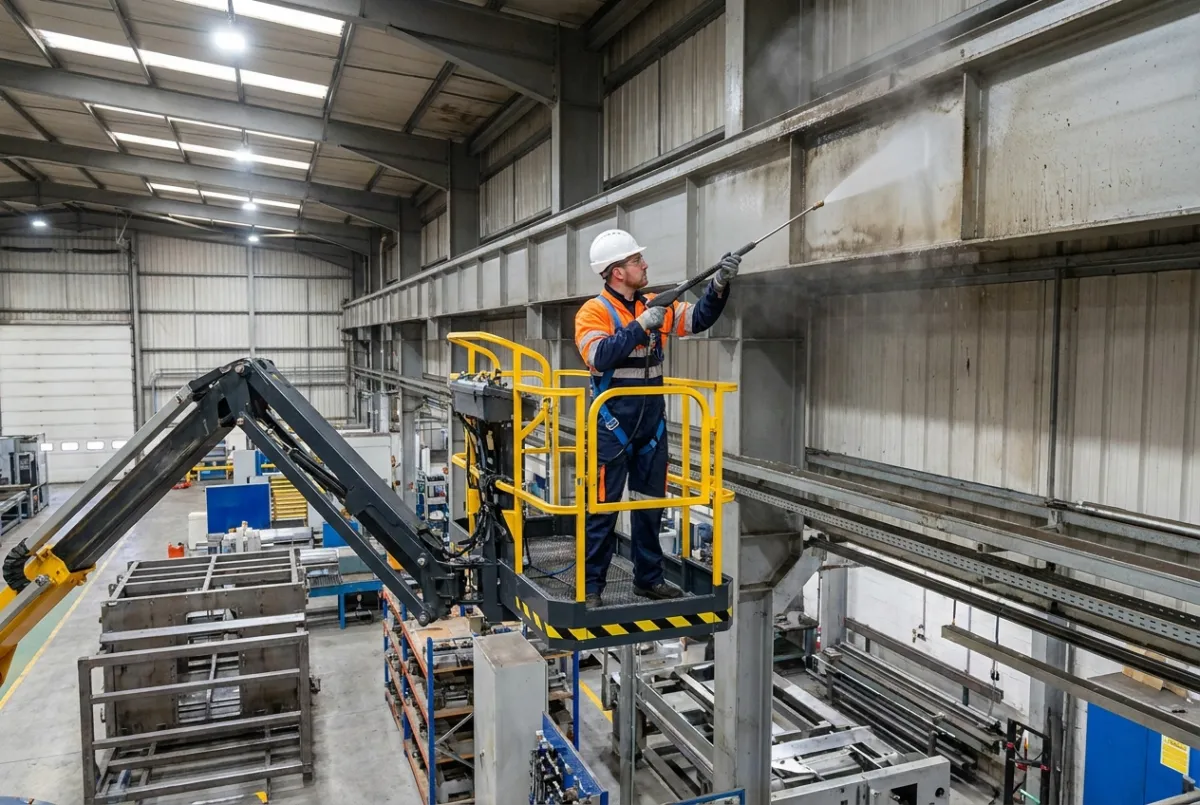
MEWPs are often the quickest answer where floor loading, aisle width, headroom and obstruction levels allow them. They can shorten mobilisation and support efficient cleaning of beams, cladding, roof voids, lighting runs and overhead services. Their limitations usually arise around access routes, floor condition, live plant congestion and the need to keep defined operating zones clear.
Rope access-led delivery
Rope access can be commercially attractive where ground obstruction makes plant access impractical or where the workface is expansive vertically but relatively light in task load. It reduces the footprint at ground level, but it is not automatically the cheapest option. Anchor suitability, rescue planning, exclusion zones and working methods still need careful design.
Scaffold-led delivery
Scaffold generally becomes more viable where repeated access is needed, where multiple trades are sharing the same elevation, where dwell time is long, or where the clean is only one part of a larger maintenance package. It lengthens setup time but can improve productivity if the workfront is broad and ongoing.
Cleaning around live operations is often the real constraint
Many industrial cleaning briefs are not shutdown briefs. They involve working while the client is still producing, dispatching, storing or processing. That changes the planning conversation completely.
Dust-sensitive lines, forklift routes, hygiene controls, temperature-sensitive areas, restricted shift windows and permit-to-work systems all influence what “simple cleaning” really means. A job that is easy physically may still be complex operationally because the wrong working method could interrupt the site more than the contamination itself.
Practical questions worth resolving early include:
can the area be isolated during the work;
is out-of-hours attendance preferable;
are there contamination risks from disturbed deposits;
will nearby plant need temporary protection;
do lighting, alarms, sprinklers or cable trays require special handling;
can waste be removed continuously or only at certain times?
On many projects, the best contractor is the one who helps narrow the live-operations impact before pricing becomes fixed. That is a better sign than a low headline rate that assumes the building will be completely empty when it is not.
If the work at height is linked to a broader industrial cleaning scope, the high-level cleaning services page is the main service route. If, during survey, it becomes clear that the issue is actually inside enclosed plant rather than simply overhead, the confined space and industrial plant cleaning route is more appropriate.
Compliance and safety planning influence productivity
Height-safety compliance is sometimes spoken about as though it sits outside the commercial discussion. In reality, it shapes productivity directly. Rescue arrangements, exclusion zones, permit systems, operative competence, edge protection, access inspections and site induction demands all affect how much useful work can be completed in a shift.
A realistic programme therefore depends on more than square metres or linear metres. Buyers should consider:
Duration of setup versus duration of cleaning
A short cleaning task can be disproportionately expensive if the chosen access method requires extensive setup and dismantling. Conversely, a more substantial access arrangement may become economical on a large or repeated scope.
Number of interfaces
Where several parties are working in the same area—maintenance, electrical, production, hygiene, roofing or painting—the sequencing burden increases. This is often where time is lost.
Nature of the contamination
Loose dust, grease, carbon, product residue and general soiling all behave differently at height. Some can be vacuumed with minimal spread. Others need wet methods or containment planning. The wrong approach increases secondary cleaning and site disruption.
Housekeeping and waste route
The route for bagging, lowering, segregating and removing waste should be considered before the work begins. On cluttered or live sites, waste movement can become a programme constraint in its own right.
What buyers should expect from a site survey
A proper survey for high-level cleaning should do more than confirm that surfaces are dirty. It should identify access constraints, operating restrictions, contamination type, surface fragility, service congestion and the likely best method for delivering the work with minimal disruption.
Good survey notes usually answer questions such as:
where can plant or scaffold be positioned;
what ground conditions or floor load limits apply;
is rope access structurally feasible;
which areas are genuinely reachable from one setup;
what can be cleaned during operational hours and what cannot;
are there hot surfaces, electrical hazards or hygiene-critical processes nearby;
what pre-clean protection is needed for stock or machinery?
If a contractor cannot explain the access reasoning, it is difficult to trust the timing or cost assumptions that follow.
Indicative pricing and programme expectations
There is no defensible flat national rate for high-level industrial cleaning. Access method, building geometry, contamination type, shift restrictions, isolation requirements and working-hours constraints all affect the cost. Travel and subsistence are also location-dependent, which matters for a UK-wide provider operating from North Wales / North West England.
Indicatively, smaller straightforward cleaning tasks reachable by MEWP can start from the high hundreds or low thousands. Larger multi-elevation works, difficult live-site cleans, scaffold-supported programmes or tasks requiring repeated attendance can rise materially from there. Rope access packages vary widely because anchor solutions, rescue planning and site constraints can either simplify or complicate delivery.
Programme lengths move in the same way. Two jobs with similar area can have very different durations if one is accessible from open floor space and the other sits above congested live plant that only allows narrow working windows.
Why ACS is often brought in for this kind of scope
Alternative Cleaning Solutions (NW) Ltd delivers industrial cleaning across the UK with a core directly managed team supported by vetted, accredited subcontractors where the scale or access profile of a project requires additional resource. That blended delivery model is often the sensible one for high-level works because access, labour and scheduling rarely scale in a perfectly linear way. The company refers to 26 years' experience and lists FSB membership, Builder's Profile Verified status and Constructionline Gold.
For a procurement contact, the more useful point is that high-level cleaning should be costed around the safest workable access method and the operational reality of the site, not around a generic day rate alone.
Where a high-level cleaning package is part of a larger fabric-maintenance programme, industrial coatings and protective painting may also become relevant once contamination is removed and substrate condition is visible.
FAQ: practical buyer questions
Which is usually cheaper: MEWP, rope access or scaffold?
There is no universal answer. MEWPs are often cost-effective on open, reachable workfaces. Rope access can reduce ground footprint where plant access is difficult. Scaffold may become the better value option where the workface is large, repeated or shared with other trades. The right method depends on geometry, obstruction, duration and site controls.
Can high-level cleaning be done while production continues?
Sometimes yes, sometimes no. It depends on what contamination will be disturbed, whether exclusion zones can be maintained, and how close the work is to active processes, people or product. Partial live operation is common, but it needs planning.
Is rope access always less disruptive than scaffold?
Not automatically. Rope access can reduce physical footprint, but anchor arrangements, rescue planning and area controls still matter. On some sites it is clearly the best route; on others it adds complexity without enough benefit.
How much notice is normally needed?
Lead time depends on access planning, permit arrangements and whether out-of-hours or shutdown attendance is required. Straightforward local works may be mobilised quickly. Larger controlled programmes need more survey and coordination time.
Do quotes vary by region?
Yes. UK-wide delivery includes location-based mobilisation costs. Travel and subsistence are built into quotations according to the actual site position and duration, rather than ignored in an artificial nationwide rate.
