
Health & Safety Requirements for Industrial Shot Blasting UK
By ACS Technical Team
Shot blasting sits at the heavier end of industrial surface preparation, and the law treats it that way. A blasting crew handles equipment under pressure, generates respirable dust from the substrate and the abrasive alike, and often works in positions where a single failure of control matters quickly. Buyers who understand which duties attach to the work, and to whom, are far better placed to judge the paperwork a contractor puts in front of them. This article sets out the legal framework, shows how the hierarchy of control is applied on real projects, explains how respiratory protection is selected and why, and describes what a genuinely compliant method statement contains.
The legal duties attached to blasting work
Three strands of law shape almost every blasting project in the UK. The Health and Safety at Work etc. Act 1974 sets the overall duty on employers to protect workers and others affected by the work, and it applies to the contractor and to the client whose premises are being worked on. The Control of Substances Hazardous to Health Regulations 2002, known as COSHH, governs the dusts the process creates, because most substrates and many abrasives release respirable particles that can include crystalline silica. Where blasting forms part of a wider construction or refurbishment package, the Construction (Design and Management) Regulations 2015 add duties around planning, coordination and welfare that apply to everyone in the chain.
Equipment law matters too. Blast pots, compressors and nozzles fall under the Provision and Use of Work Equipment Regulations 1998, which require equipment suitable for the task, properly maintained and inspected. Where work at height or in restricted areas is involved, further regulations layer on top. None of this is exotic, but the interactions are why blasting is rarely something to hand to a labour-only supplier.
Applying the hierarchy of control
COSHH does not start with masks. The regulations expect exposure to be prevented where reasonably practicable, and only then controlled, following a hierarchy that runs from elimination through engineering controls to administrative measures and, last of all, personal protective equipment. On a blasting project that hierarchy has visible, practical expression.
Elimination and substitution come first. Choosing a less dusty abrasive, or a method that throws less media into the air, reduces exposure before anyone puts anything on. Where blasting can be done in a controlled workshop environment rather than in the open, the boundaries of the work become easier to manage. Engineering measures follow: on plant and internal structures that can be closed and ventilated, capturing dust at source changes the exposure picture substantially. Administrative controls come next, meaning limits on exposure time, excluding unprotected people from the area, and sequencing work so that blasting happens when the fewest people are around. Respiratory protection is the last line, and it protects the operative only when everything before it has been accounted for.
Respiratory protection: how selection actually works
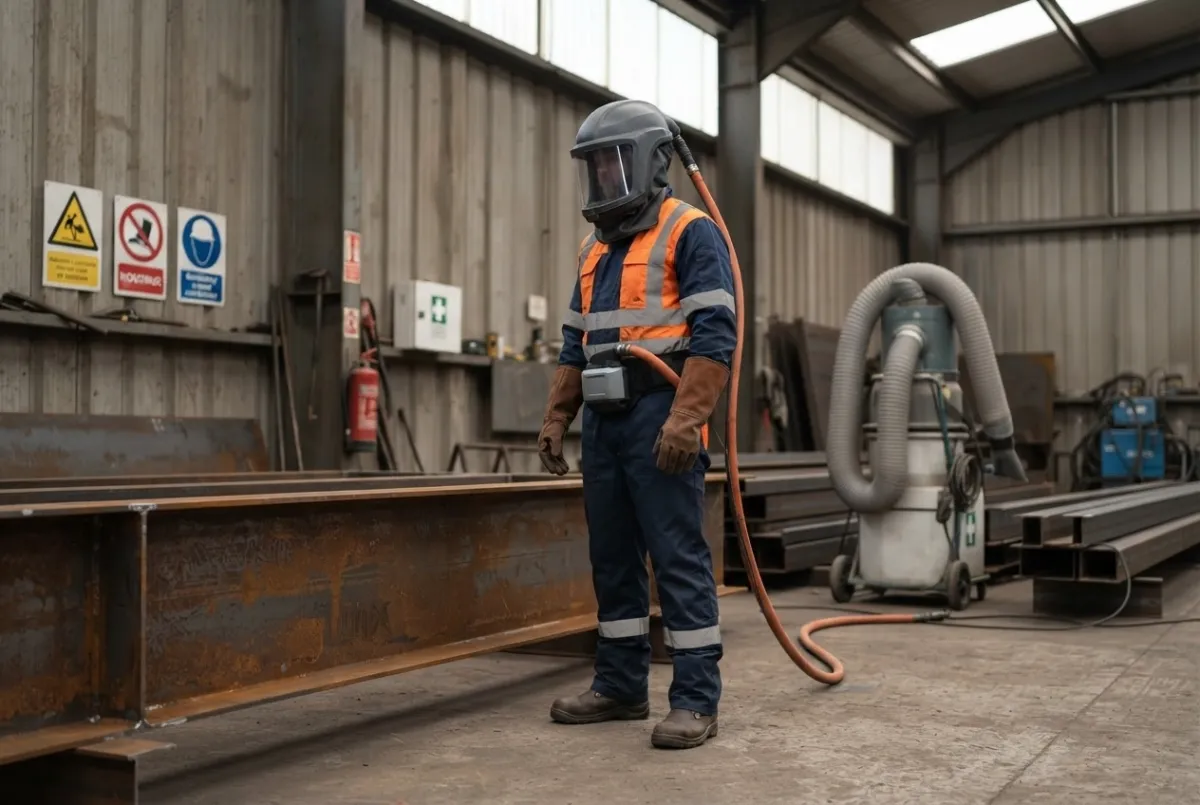
Blasting generates exposure levels high enough that simple filtering face masks are rarely adequate as the primary defence. The operative stands in the contaminant cloud they are creating, so the expectation on a well-run job is supplied-air respiratory protection, typically a hood or helmet fed with clean compressed air, with the assigned protection factor matched to the assessed exposure. Where ancillary tasks such as pot operation, screening or waste handling sit outside the direct blast stream, correctly fitted filtering facepieces or powered hoods may be appropriate for those roles instead. The HSE publishes direct advice on RPE selection, and it is the reference most competent method statements are written against.
Fit and maintenance decide whether any of this works. Tight-fitting facepieces require individual face-fit testing, and a clean-shaven policy at the sealing surface is not negotiable. Supplied-air systems need genuinely clean air: compressors used for breathing air must be sited away from exhausts and monitored accordingly. Records of tests, filter changes and hose inspections should be available for review, because an RPE regime that exists only on paper fails exactly when it is needed most.
What a compliant method statement contains
A method statement is the document a buyer should be able to audit before anyone mobilises. On a blasting job it should name the substrate and any coating to be removed, because that determines the hazard profile: silica-bearing concrete, lead-based paint on older steelwork and marine coatings each change the assessment. It should specify the abrasive, the equipment, the boundaries of the work area and how those boundaries will be policed. It should state who the supervisor is, what competencies the crew hold, and how access will be gained and controlled.
The health section should identify the substances generated, the controls in priority order, and the RPE regime with its supporting face-fit and air-quality records. Waste handling deserves its own attention: spent abrasive and removed coating carry the contaminants of the substrate, and the statement should describe how they are collected, stored and consigned. Finally, the statement should cover the abnormal and the emergency, meaning what happens if the equipment fails mid-blast, if the weather turns on an open site, or if an operative signals distress. Vague statements that promise to comply with all regulations without describing any of this are a warning sign, not a shortcut. Where the work involves entering vessels or pits rather than blasting them from outside, the arrangements described in our article on confined space plant cleaning apply in parallel, and the two sets of controls must be written to work together.
The technical side of the process itself, from media selection to cleanliness grades, is covered in our guide to industrial shot blasting practice, and the safety case should always be read alongside that specification rather than instead of it.
How ACS delivers against these requirements
ACS delivers shot blasting and surface preparation across the UK on the basis described here: surveyed, specified work with the health and safety paperwork built around the actual substrate and access rather than recycled from a template. Buyers are welcome to ask for the method statement and RPE records described above before award, because a competent contractor will expect the request.
Where audits most often find gaps
Site audits on blasting projects tend to find the same handful of gaps, and none of them are exotic. Respiratory protection records are the most common: face-fit certificates that have lapsed, hood components with no inspection history, and breathing-air tests that cannot be produced on request. Equipment documentation runs close behind, with blast pots and compressors missing current inspection records. The third recurring finding is a work-area boundary that exists on the drawing but not on the ground, where sheeting or barriers have drifted since the first shift. None of these findings is expensive to prevent, and all of them are visible to a buyer who asks to see the records rather than the summary.
Competence records worth asking to see
A crew file tells you more in five minutes than a policy document does in twenty. For each operative it should show training relevant to blasting and to the plant being used, current RPE fit-test records where tight-fitting masks are worn, and briefings for the specific site rather than a generic induction. For the supervisor it should show evidence of planning responsibility, not merely presence on the day. Audit-style checks like these are reasonable before award and normal during delivery, and contractors used to regulated environments expect them. Asking for them late is still worth doing; asking for them at tender is better, because the response becomes part of the evaluation and shapes the choice before the contract is signed.
Frequently asked questions
Does blasting always need supplied-air respiratory protection?
For the operative holding the nozzle, in practice yes, because exposure at the blast point is high. Supporting roles away from the stream may be assessed separately and given protection appropriate to their measured exposure.
Who is responsible for dust controls, the client or the contractor?
Both, in different ways. The contractor controls the process; the client controls the site, the information about substrates and coatings, and the interfaces with other work. CDM duties sit with everyone in the chain.
Is face-fit testing a one-off exercise?
No. Fit testing should be repeated when the model or size of mask changes and periodically as good practice, and it must be documented. A pass with one mask model does not transfer to another.
What should I ask to see before work starts?
The site-specific method statement, the COSHH assessment, face-fit records for the crew, and inspection records for the blast equipment. Site-specific means written for your substrate and access, not a generic document with a logo on it.
Does old paint change the risk?
Substantially. Coatings containing lead or chromates turn the debris into a hazardous substance with its own controls, so the assessment must know the coating history before the first nozzle is opened.
