
COSHH & Dust Control for Industrial Blasting Projects UK
By ACS Technical Team
The dust a blaster breathes is the health legacy of the job, long after the surface is handed over. Respirable crystalline silica from concrete and masonry, metal particles from the substrate, breakdown products from the abrasive and debris from old coatings all travel on the same airstream, and the controls that stand between them and human lungs are legal requirements, not options. This article explains how a proper COSHH assessment is built for an industrial blasting project, how exposure is controlled in practice on outdoor work, and how respiratory protection is selected, tested and reviewed.
The COSHH assessment on a blasting project
An assessment worth its name starts with the substances actually present, and on a blasting job that means four families. The substrate contributes its own dust: concrete and masonry release respirable crystalline silica, which carries a workplace exposure limit of 0.1 milligrams per cubic metre as an eight-hour time-weighted average, and steel substrates contribute iron oxide and whatever the mill added. The abrasive contributes depending on type, which is why media selection is a health decision as much as a finishing one. Any coating being removed joins the list, and older coatings can bring lead or chromates into the debris stream with their own controls. Finally, fuel and engine exhausts from plant supporting the work belong in the assessment rather than outside it.
Each substance is compared against its exposure limit, with exposure estimated from the task, its duration and the operative's position in the airstream. The assessment then drives the controls in COSHH's required order: prevent exposure where reasonably practicable, otherwise control it adequately, and prove both through monitoring and health surveillance where the risk demands it.
Controlling exposure on outdoor blasting projects
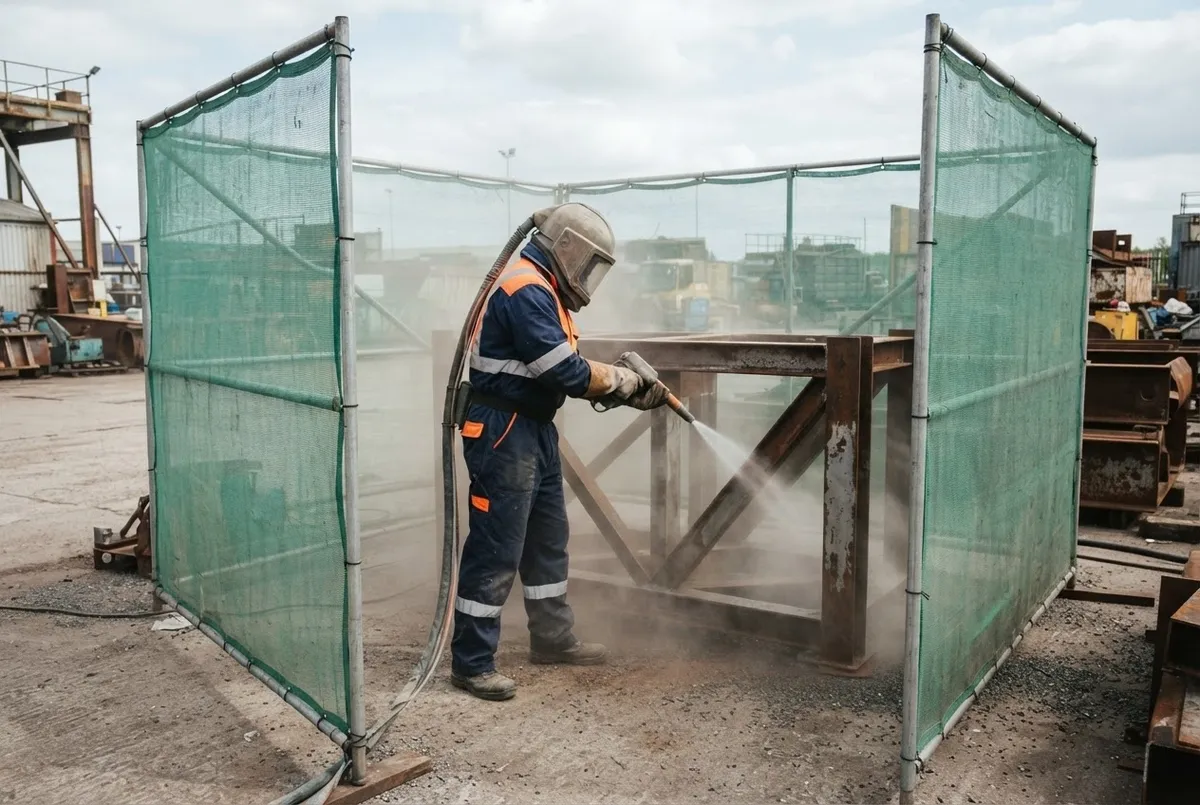
On open-air and outdoor blasting, the primary control for the operative is supplied-air respiratory protective equipment: a hood or helmet fed with clean compressed air, so the operative breathes from a protected source rather than from the cloud they are creating. This is the control that does the heavy lifting, and it is sized by the assessed exposure of the actual task. Positioning and working method support it: crews work to the wind where conditions allow, plant is sited so exhausts do not feed the breathing-air compressors, and damping or media choices reduce the dust raised in the first place.
Perimeter screening then acts as a supplementary measure whose job is different: it protects everyone outside the immediate work area. Sheeted screens and exclusion distances keep drifting debris and dust away from other trades, the public and neighbouring premises, and housekeeping collects spent media so it cannot be re-suspended by traffic or wind. The order matters and is worth stating plainly to buyers, because the operative's supplied-air hood is the primary control on outdoor work, while screening and housekeeping protect the people around the job; neither substitutes for the other, and both appear in the method statement with named responsibilities.
RPE selection, fit testing and maintenance
Selection follows the assessment rather than the catalogue. Continuous-flow supplied-air hoods are the standard answer for the blasting operative; supporting roles such as pot operation, screening and waste handling may be assessed separately and issued with tight-fitting respirators or powered hoods where their measured exposure allows. Tight-fitting facepieces only perform with a good seal, which is why individual face-fit testing is required and a clean-shaven sealing surface is enforced without exception. Breathing air itself is a supply-chain control: compressors used for respirable air are sited, filtered and tested to the air quality standard, with records kept alongside filter changes and hose inspections.
Monitoring, health surveillance and review
COSHH does not end when the method statement is printed. Exposure monitoring against the relevant limits, whether personal sampling or real-time dust measurement, tells you whether the controls are working as designed, and it belongs on projects where the assessment says the risk justifies it. Health surveillance, through respiratory questionnaires and occupational health review, closes the loop for the individual. And the whole control set is reviewed whenever something changes: a new substrate, a different abrasive, a changed working pattern or a monitoring result that surprises anyone. An assessment that has not been touched since the first mobilisation is a document, not a control.
Dust control with ACS
ACS runs dust-controlled blasting services on exactly this structure: substrate-aware assessment, supplied-air RPE as the primary control outdoors, screening and housekeeping protecting everyone else, and monitoring and review keeping the paperwork honest. The methods being controlled are described in our guide to how blasting methods differ, and the legal duties behind them in our article on the legal duties for blasting. HSE's COSHH hub, at HSE's COSHH resources, is the reference the assessment framework is built on.
Waste handling as a dust source
Spent abrasive and removed coating are not just a disposal question; they are a dust question for as long as they sit on site. Bags split by handling, heaps disturbed by wind and vehicles, and skips loaded dry all re-release what the controls captured during blasting, so the method statement should treat collection and storage as part of the exposure regime rather than an afterthought. Damping where the waste allows it, covered storage, and loading plans that keep people upwind are ordinary measures that cost little. Disposal routes then finish the job: classified correctly, consigned properly and removed on a schedule that does not leave last week's waste greeting this week's wind. The discipline is unglamorous and decisive: waste managed from first collection to final consignment never becomes the dust event that undoes an otherwise controlled job.
Competence and training behind the controls
Controls work when the people behind them know why they exist. Operatives need more than a mask issue: they need to understand what the assessment found, which control does what, and what to do when something changes, such as a wind shift or a new substrate appearing mid-job. Supervisors need the same understanding plus the authority to stop and adjust. Refresher briefings keep the knowledge current, and toolbox talks tied to the actual site keep it specific. Buyers who sit in on one briefing usually learn everything they need about how the controls will behave on day thirty.
When monitoring changes the plan
Monitoring exists to change behaviour, not to fill folders. Personal sampling results that sit higher than the assessment predicted should trigger a review of controls, and the review should reach a documented conclusion rather than a shrug. Real-time dust readings during the job flag tasks that behave worse than planned, such as particular media or working positions, and the response is a method adjustment while the crew watches. Over time, the results build a picture of how the crew's standard methods perform, which is exactly the evidence a serious contractor brings to the next assessment.
Two adjacent risks deserve mention in the same breath as dust. Noise from compressors and blasting affects hearing over a career, and the assessment should treat it alongside respiratory risk rather than after it. Vibration from lances and surface preparation tools adds its own exposure, managed through tool selection and exposure time. Neither risk replaces the dust regime; both sit in the same method statement with the same review cycle, because the operative's health is one ledger with several entries.
Dust and COSHH questions
Why is a hood necessary outdoors when the space is open?
Because the operative stands inside the dust cloud they generate, whatever the weather is doing. Open air dilutes the plume for people further away, not for the person holding the nozzle, which is why supplied-air RPE is the primary control outdoors.
What do perimeter screens actually achieve?
They protect other people: nearby trades, the public and neighbours. Screening is a supplementary measure for those outside the work area and never replaces the operative's own respiratory protection.
Does the abrasive choice change the health risk?
Yes. Media differ in the dust they generate and in what they can carry, so selection is part of the assessment, alongside what the substrate and any removed coatings will contribute.
How often is face-fit testing repeated?
When the make, model or size of facepiece changes, and periodically as good practice. Results are documented per individual, and a pass on one model tells you nothing about another.
What triggers a review of the COSHH assessment?
Any material change: new substrate or coating, a different abrasive or equipment set, changed hours or location, or monitoring or health findings that suggest the controls are not performing as assessed.
