
Industrial Shot Blasting Services Across the UK
By ACS Technical Team
A blasting crew that can work in South Wales, Teesside and the Central Belt within the same quarter is not simply a local firm with a bigger map. Nationwide delivery is organised differently: mobilisation is planned as a discipline in its own right, the on-site versus workshop decision is made deliberately for each component, and the plan changes with every site's access, ground and neighbours. This article describes how that works across the UK, because buyers who understand mobilisation can compare bids on delivery reality rather than geography.
On-site or workshop: how the decision is made
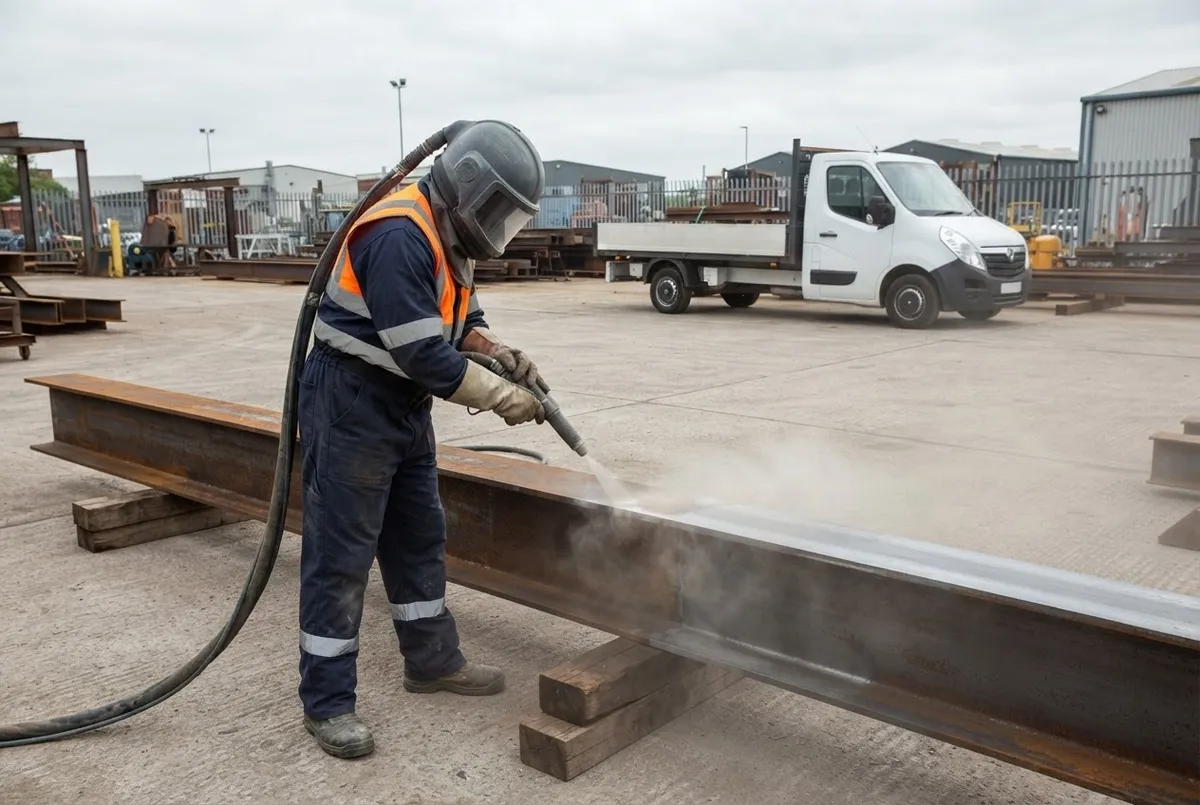
The first fork in any package is whether the asset comes to the blast shop or the blast shop goes to the asset. Workshop blasting suits components that can be transported: fabrications, platework, doorsets, small vessels and frames. In the shop, the operative stands on solid floors with media recovery, lighting and weather removed from the equation, and cleanliness is easier to hold between blasting and any coating that follows. On-site blasting suits the majority of industrial packages precisely because most assets are fixed: structural steelwork, plant, tanks, floors and buildings cannot come to anybody.
The decision is economic as much as technical. Transporting a heavy fabrication twice, with lifting at each end, can cost more than mobilising a crew to its current location. The reverse is equally true: shipping a crew and plant for two small components is rarely sensible when a workshop with the right recovery system is already running. Size, weight, deadline and the coating programme around the work all tip the answer, which is why the question is asked at survey stage rather than after the award.
What mobilisation actually involves
Mobilising a blasting package moves more than an operative and a pot. Blast pots, compressors and air-drying plant travel by road under weight and securing rules; abrasive arrives in bulk and needs dry, vermin-free storage once it lands; welfare, power and waste routes are established before the first nozzle opens. On remote or rural sites, fuel, accommodation and delivery lead times shape the programme as much as the blasting itself, and a realistic mobilisation window protects the schedule from its most avoidable delays.
Distance carries cost honestly when it is stated. ACS operates UK-wide from a North Wales and North West England base, and travel, accommodation and mobilisation are built into pricing according to where the work sits and how long it runs, so a fortnight in Cumbria is costed differently from a day in Wrexham and the quotation says so. Buyers comparing national bids should check that each one prices mobilisation on the same basis, because the differences hide in exactly that line.
How location and access change the plan
Every site rewrites part of the method. A constrained urban yard limits plant parking, hose runs and delivery windows; an open process site gives room to position equipment but adds live-plant interfaces; a coastal or island location adds weather, tide and ferry timetables to every material movement. Ground conditions decide where compressors and pots can stand, and crane or forklift availability decides how far plant has to be manhandled. Access height pushes work towards platforms or rope access, which introduces contractor questions of the kind covered in our article on vetting a blasting contractor.
Containment and housekeeping by site
What surrounds the work decides how debris is managed. Open ground with a generous exclusion distance allows simple screening and collection; work over drains, watercourses or neighbouring property needs sheeting, bunding and disciplined housekeeping so that spent media and removed coating land where they can be picked up. None of this is glamorous, and all of it is where careless contractors lose control of a site. The technical standards the blasting must hit, whatever the site throws at the crew, are the same ones described in our guide to industrial blasting standards.
ACS coverage across the UK
ACS delivers nationwide blasting mobilisation on the model described here: surveyed before pricing, mobilised to a plan built for the specific site, and supervised by the same team from first arrival to handback. Buyers procuring across multiple sites gain most from one contractor who can evidence the same method and the same standard everywhere.
Weather and season across the UK
Nationwide work meets weather that varies by more than discomfort. Western coasts carry moisture that shortens the window between blasting and coating; inland winters bring dew conditions that push start times later; high summer brings its own limits around heat stress and rapid oxidation on hot steel. Programmes built for one region quietly fail when copied to another, which is why the method statement is written per site rather than per contract. Season matters for media and waste too: wet storage ruins abrasive, and saturated debris changes weight and classification. Buyers scheduling sensitive packages should ask how the plan changes in the shoulder months, because the answer separates crews who have worked through a northern winter from crews who have read about one. Crew exposure expectations also travel with the job, and the health standards a blasting crew works to, including HSE notes for abrasive blasters, are the same anywhere in the country, which is one more reason method and supervision should not vary by geography.
One contractor across multiple sites
Buyers with several estates gain the most from consistent national delivery. One method structure means one set of documents to learn, one escalation route, and findings from one site informing the next. Plant and media logistics can be shared across nearby jobs, and supervision standards can be audited against each other rather than assumed. The alternative, buying site by site from whoever is local, buys familiarity with the postcode and loses the specification. Where a mix of suppliers is unavoidable, ask each to bid against the same survey and the same standard, so the comparison measures competence rather than geography. Consistency also shows in how changes are handled. A national supplier should evidence the same RPE regime, the same waste routes and the same reporting format wherever the work lands, because the buyer's audit function depends on comparability. Where local constraints demand a different method, the difference should appear in documents the buyer signs, not in improvisation the buyer discovers. Multi-site buyers should also standardise the survey template, because comparable surveys are what make national prices comparable.
Contingency belongs in the mobilisation plan rather than in the price alone. Vehicles fail, ferries cancel, and access equipment arrives with a fault on the morning it is needed. A national crew that plans spare capacity, alternative routing and a supplier network it has actually used recovers those days; a crew that plans none of them spends your window learning. Ask what the plan does on the day the compressor will not start, three hours from the nearest depot. The answer is a better test of a national operation than any map with pins in it.
Programme length also changes what national delivery means. A single week of work far from base prices very differently from a rolling programme of visits, because the mobilisation spreads across more productive days. Buyers with recurring needs across several regions should say so at enquiry, since the shape of the programme is often worth more than the size of any single job.
Questions about nationwide delivery
Do you charge extra for distance?
Yes, priced openly. Distance enters through travel, accommodation and mobilisation, all shown in the quotation, which is why a remote fortnight prices differently from a local day.
Can small components come off site instead?
Where transport and lifting make it sensible, workshop blasting is often the better and cheaper route, with the component returned ready for coating. The survey identifies which items suit the shop and which do not.
How far in advance should we book a national package?
The earlier the survey, the better the mobilisation plan. Abrasive supply, plant transport and any specialist access equipment all carry lead times, and remote sites add their own; a few weeks of planning protects the working window.
What if our site has restricted delivery hours?
Constrained sites are normal. Delivery windows, night mobilisation and phased plant movements are planned around the restrictions you declare, which is one more reason the site survey happens before the price is fixed.
Is the standard the same everywhere in the UK?
The specification travels; the method adapts. Cleanliness grades and profile requirements are fixed by the coating specification, while access, containment and sequencing flex to each site's reality.
